family tree assignment
Lessons in ChemistryThe family tree assignment begins as a classroom exercise in identifying relatives, but for Madeline Zott it becomes a pointed question about the family she has and the father she never knew. Its branches invite names organized by birth and marriage; Madeline’s answers instead make room for grief, care, and chosen kin. The assignment’s importance lies in that mismatch: a form meant to describe family cannot contain the relationships the story makes visible.
A classroom exercise becomes personal
In May 1960, Mrs. Mudford introduced a project called All About Me and asked the children to have their mothers fill out a family tree. She explained that the exercise would help them learn about an important person, with the answer supposedly supplied by the project’s title. The instruction made a private family history into schoolwork, something to be completed and returned through an adult.
For Madeline, the request immediately touched what she did not know: anything about her father. The worksheet’s oak demanded the names of relatives, and Madeline understood that her mother would have to supply the answers. When she told Harriet Sloane about the project, Harriet objected to its assumptions. She saw the tree as a poor way to make someone feel like a person through other people, and as an intrusion into a family’s privacy. Her reaction identifies the problem before the assignment is even filled in: its apparently neutral categories can demand disclosure from a child whose family history is painful and incomplete.
Madeline did not simply abandon the task. She tried to find information, asking the school librarian for Cambridge yearbooks, but the librarian gave her a copy of Highlights magazine instead. The failed search underlines the difference between being asked to document a family and having access to the records that might answer the questions. The school provides a form; it cannot provide the knowledge Madeline seeks.
The tree and the family photograph
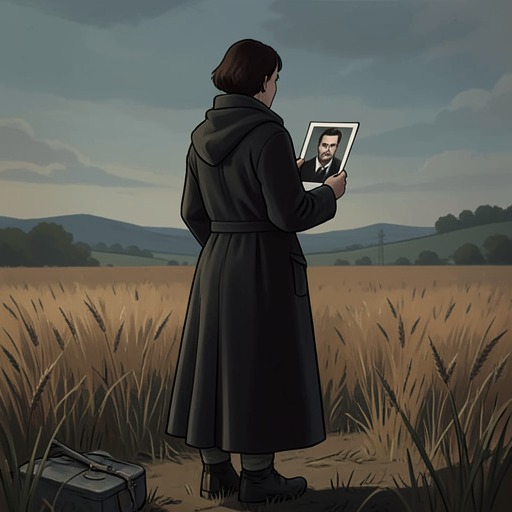
The assignment also required a family photograph. Madeline brought Reverend Wakely a clipping from Calvin Evans’s funeral, the only picture she could identify as showing the whole family. The photograph showed Elizabeth Zott and Six-Thirty from behind as they watched Calvin’s coffin being lowered into the earth. Madeline explained the image by locating herself inside Elizabeth, her father in the coffin, and Six-Thirty beside them. What the form could not show as a conventional portrait, the clipping recorded as loss and connection.
Reverend Wakely, who had spent years consoling others, was depleted by Madeline’s matter-of-fact account of her grief. Looking at the picture, he noticed that his own hands were in it too. He told her that families were not meant to fit on trees and contrasted the plant image with human membership in the animal kingdom. Madeline recognized his point as the one she had been trying to make to Mrs. Mudford. The exchange does not deny biological relationships; it challenges the tree’s claim to be an adequate picture of family.
When Elizabeth later spoke with Madeline about the photograph and the attached tree, she found an acorn labeled Fairy Godmother. At the bottom, Madeline had written “Humans are animals” and underlined it three times, followed by “Inside, humans are genetically ninety-nine percent the same.” The acorn gives the diagram a place for a relationship not defined by descent, while the statement about shared genetics widens its scale beyond the individual family. Madeline has used the school form not only to answer its demand but to question the assumptions built into it.
A document shaped by competing ideas of kinship
Other relationships in the story reinforce the distinction Madeline is making. Walter Pine learned that Amanda was not biologically his daughter, but the test results did not alter his love or his sense of himself as her father. He concluded that biology was overrated. His experience supplies a direct counterexample to the idea that DNA alone establishes family: the relationship existed through fatherhood and attachment before, and continued after, the test.
The family tree assignment’s meaning also changes when it leaves Madeline’s hands. In a Life magazine article, Mrs. Mudford’s criticism of Elizabeth’s parenting was accompanied by a copy of Madeline’s tree, marked “Lies! See me!” The tree, more than anything else in the article, harmed Elizabeth. A child’s attempt to explain her family had become evidence in an adult’s public case against her mother. The episode reveals that the document is not merely a private record: whoever possesses or interprets it can use its categories to judge a family.
The family Madeline names
The tree’s final significance emerges in Madeline’s choice of whom to include. When Avery Parker later hoped to become part of the family, Elizabeth welcomed her and said Madeline had understood this long before: it was Avery, not Wilson, whom Madeline had put on the family tree. The assignment that began with a school’s fixed template thus preserves a different kind of answer. Its branches can register not only inherited relations but the belonging Madeline recognizes and grants.
Across the project’s episodes, the tree shifts from an imposed classroom exercise to Madeline’s argument about family, then to a document others can distort, and finally to evidence of her own judgment. Its form suggests that kinship is orderly, legible, and rooted in descent; the people attached to it show that care, memory, grief, and chosen inclusion also make a family. Madeline does not reject family history. She insists that the picture be large enough to include the living relationships the worksheet cannot predict.